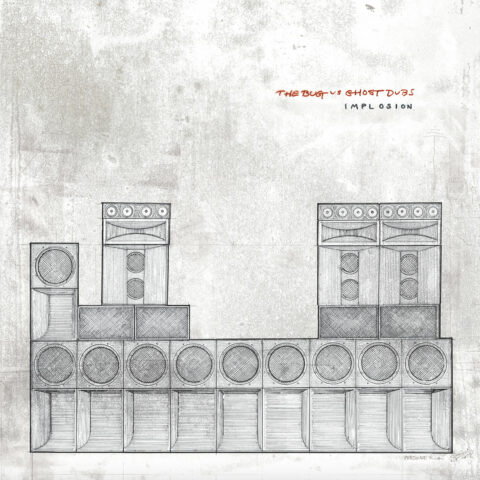
Heavier, slower, the better.
It begins with just a bassline. The Bug’s “Hooked (Hyams Gym, Leytonstone)” where the beat arrives late, layering in gradually. Then Ghost Dubs’ “In The Zone” — foggy, muffled soundscapes resonating from somewhere far away.
The approach evokes Rhythm & Sound: raw, stripping away ornamental flourishes into pure minimalism, imagined for sound systems in the field while simultaneously focused on how to elevate that live experience into an album. The heavier, the better. The slower, the better — as if that’s the only justice that matters. “Dub Remote” allows nothing but closing your eyes and immersing yourself in sound, ignoring all daily noise. It doesn’t demand you to be in a place with a superior sound system. Close your eyes, and you can dance with sonic ghosts in your consciousness. A profound record.
Kevin Martin, aka The Bug, presents the concept of “spectral dub” on this split album released via his own label Pressure. It’s his attempt to capture Jamaican music that has long captivated him in his own way. His counterpart, Ghost Dubs — Stuttgart producer Michael Fiedler — has led the German sound system scene under the name Jah Schulz, reportedly receiving support from legendary sound systems like Jah Shaka and Iration Steppas. Following his 2024 album “Damaged” which gained international attention, he and The Bug clash viscerally in a sound clash format, alternating tracks.
Elements from this album were first unveiled by The Bug at Berlin’s Gretchen and London’s Colour Factory. The Bug’s tracks bear location names like “Hooked (Hyams Gym, Leytonstone)” and “Burial Skank (Mass, Brixton)” — clearly suggesting the memory of sound systems played in each space. At the sold-out Berlin event, their first B2B set was performed, testing this introspective material amidst a sweat-drenched crowd.
However, I only learned about their activities when tasked with writing this review — I had missed their Berlin performance. “What the hell am I even doing in Berlin?” I thought, while realizing that my antenna couldn’t catch it as I was preoccupied with finding a new place amid soaring prices and life changes. Struggling to secure a stable environment, immersed in DUB within this tough political and economic climate — their attitude to expand beyond narrow worldviews and push the genre’s boundaries became all the more apparent to me. Dark and heavy, strictly industrial and real. That’s precisely why there’s raw, visceral hope and longing here.
As the album progresses into its latter half, that fundamentalist aspect thins, and various sounds mix into the muffled beats, heightening immersion. Simply put, it never gets boring. To listen to deep emotions before words, to gain strength to survive without turning away from the frustrating everyday — I need to return to Berlin, to the dance floor. No matter how slow, once the bassline resonates and your hips start moving, your body moves. Then just listen to the details you naturally perceive, and bring those realizations back to daily life. And when that’s not possible, just escape into the sound through headphones.
Europe’s cost of living is incomparable to Japan’s, and the reality of immigrant culture isn’t all sweet. It’s not a utopia — what many immigrants create is friction and collision. I’m one of those immigrants constituting this city, but it’s precisely in this friction that sound gains conviction. During my New Year’s return home in Kawagoe, listening to music, I surrender to the slow, heavy tracks still echoing nightly everywhere, linking back to the experience two years ago at Fold in London, swaying at a Channel One event with people whose faces I couldn’t see. It synchronizes with the experience of listening to Rhythm & Sound albums that a friend taught me — a friend who decided to leave Berlin (saying this city no longer has its former brilliance, choosing to return home to Chile). That the mastering was handled by Stefan Betke, aka Pole, following Basic Channel’s lineage, feels too perfect to be coincidence. An album resonating in these turbulent times, achieved precisely because of their fundamentalist commitment in a positive sense, or because it was created in a VS structure. Their hypnotic approach will be passed down to the future as an escape from daily noise of our times, or perhaps as the thing itself. Just shut up and listen from “Duppied (Brixton Rec)” to “No Words” at the end. Please, let no one interrupt you then — may you breathe only within the sound. (Hiroyoshi Tomite)